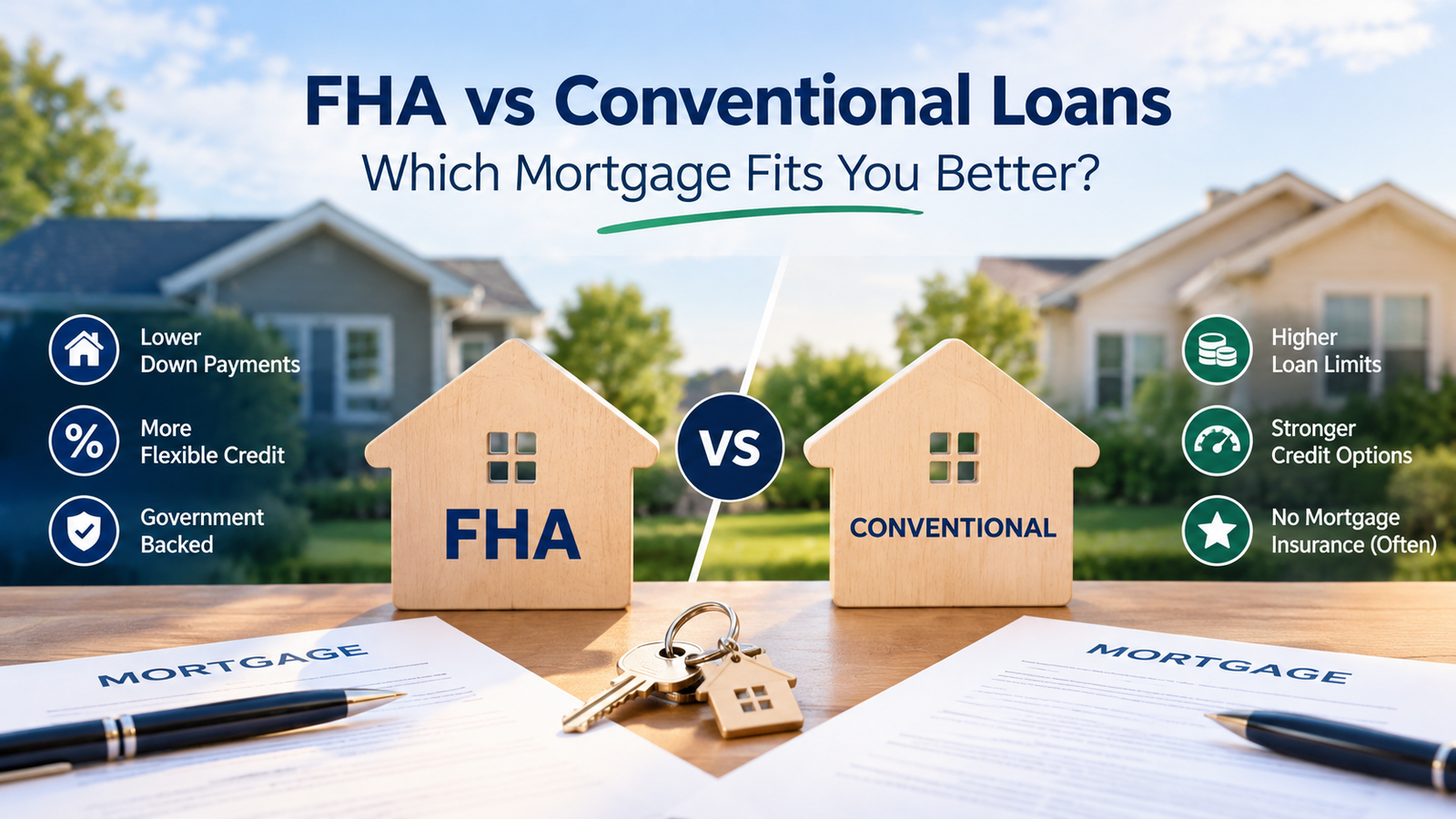
FHA loans may suit buyers with lower credit scores, while conventional loans may offer better value for buyers with stronger credit. FHA down payments can start at 3.5%, and some conventional loans allow 3% down. The better choice depends on your credit, savings, mortgage insurance costs, and monthly budget.
Buying a home already comes with plenty of decisions. Your mortgage shouldn’t feel like another puzzle. Maybe you’ve saved enough for a small down payment, but you’re worried about your credit. Or perhaps your credit is strong, and you want to keep your long-term costs down.
Comparing FHA vs conventional loans can help you understand your options before you commit.
What’s the Difference Between FHA and Conventional Loans?
An FHA loan is a mortgage insured by the Federal Housing Administration. You borrow through a lender, and FHA insurance helps protect that lender if you don’t repay the loan. This backing allows more flexible credit requirements for eligible borrowers.
A conventional loan isn’t insured or guaranteed by a government agency. Many conventional mortgages follow standards set by Fannie Mae or Freddie Mac, though other conventional options exist.
Here’s a quick comparison:
| Feature | FHA Loan | Conventional Loan |
|---|---|---|
| Government backing | Insured by the FHA | No government insurance or guarantee |
| Minimum down payment | As low as 3.5% for eligible borrowers | As low as 3% through certain programs |
| Credit requirements | Generally more flexible | Requirements depend on the program and lender |
| Mortgage insurance | Upfront and ongoing premiums generally apply | PMI generally applies with less than 20% down |
| Insurance removal | Depends on the original down payment and loan rules | Borrower-paid PMI can generally end when requirements are met |
Program rules and lender requirements affect what you’ll qualify for. Treat this table as a starting point for comparing actual offers.
How Much Down Payment Do You Need?
You don’t always need 20% down to buy a home.
Under FHA rules, borrowers with a qualifying credit score of 580 or higher may be eligible for a 3.5% down payment. Scores from 500 to 579 generally require at least 10% down. Lenders can set stricter requirements, and meeting the score threshold doesn’t guarantee approval.
Some conventional programs allow 3% down, although eligibility requirements apply. Other borrowers may need a larger down payment.
For a $300,000 home, the down payment alone would be:
| Down Payment (%) | Amount ($) |
|---|---|
| 3% | $9,000 |
| 3.5% | $10,500 |
| 5% | $15,000 |
| 10% | $30,000 |
| 20% | $60,000 |
These figures don’t include closing costs or other funds you may need.
The smallest down payment isn’t automatically the best choice. You’ll also want money left for moving, repairs, and unexpected expenses. Ask for estimates at different down payment levels so you can see what changes.
How Does Your Credit Affect the Choice?
Your credit history helps lenders assess how you’ve managed borrowed money. It can also affect your interest rate and mortgage insurance costs.
FHA loans generally allow lower credit scores than most conventional options. That can make them worth exploring if your credit is still improving.
Stronger credit can make conventional financing more competitive. In particular, conventional private mortgage insurance is generally less expensive than FHA insurance for borrowers with good credit.
Don’t choose a mortgage based only on a score you’ve seen in an app. Ask your lender to review the credit information used for your application and explain which programs fit your full financial picture.
FHA Mortgage Insurance vs Conventional PMI
Mortgage insurance is one of the biggest differences between these loans. It protects the lender, and its cost affects what you pay.
FHA Mortgage Insurance
Most FHA purchase loans include an upfront mortgage insurance premium and an annual premium paid through monthly installments. The upfront premium can often be added to the loan, but that increases the balance you’re borrowing.
For most new FHA purchase loans:
- With less than 10% down, annual mortgage insurance generally lasts for the loan term.
- With at least 10% down, annual mortgage insurance generally lasts 11 years.
Note: Reaching 20% equity doesn’t automatically remove FHA mortgage insurance.
Conventional Private Mortgage Insurance (PMI)
With a conventional loan, private mortgage insurance, usually called PMI, generally applies when you put down less than 20%.
For many conventional mortgages, you can request cancellation when the principal balance reaches 80% of the home’s original value, subject to conditions. Automatic termination generally occurs when the balance is scheduled to reach 78%, provided you’re current on payments. These rules generally concern borrower-paid PMI and have exceptions.
That potential end date matters when you’re comparing costs over several years.
Which Loan Has the Lower Monthly Payment?
Neither loan type always has the lower payment.
The result depends on the interest rate you’re offered, your loan amount, the term, and mortgage insurance. Property taxes, homeowners insurance, and any homeowners association fees also affect your housing budget.
A lower interest rate can look attractive, but it doesn’t tell you the full monthly cost.
Ask for a breakdown showing:
- Principal and interest.
- Monthly mortgage insurance.
- Estimated property taxes.
- Homeowners insurance.
- Any applicable association fees.
Compare offers using the same purchase price, down payment, and loan term. Also check whether one offer requires you to pay discount points upfront to get its quoted rate.
When Might an FHA Loan Fit Better?
An FHA loan may be worth considering if your credit history makes conventional financing less competitive or harder to qualify for.
For example, you might have steady income and enough savings for a down payment, but an older credit problem is still affecting your options. FHA financing could be part of that conversation.
The Consumer Financial Protection Bureau notes that FHA loans can often be a less expensive option for borrowers with lower credit scores or smaller down payments. That still needs to be checked against your actual offers.
Before choosing FHA, make sure you understand both the upfront insurance cost and how long monthly premiums will apply.
When Might a Conventional Loan Fit Better?
A conventional loan deserves a close look if you have stronger credit, a larger down payment, or competitive PMI pricing.
It may also appeal to you if you want a loan with borrower-paid mortgage insurance that can end once you meet the cancellation requirements.
You don’t have to wait until you’ve saved 20% to compare conventional options. A smaller down payment may still work, depending on your eligibility and the total cost.
The useful question is, “What will each option cost me?” Ask for the numbers rather than assuming a conventional loan is out of reach.
How to Compare FHA and Conventional Loan Offers
Request Loan Estimates for the options available to you. These documents let you compare the proposed loan terms and costs in a consistent format.
Look at more than the advertised rate:
| What to compare | Why it matters |
|---|---|
| Interest rate | Affects your principal and interest payment |
| APR | Helps compare borrowing costs, including certain fees |
| Mortgage insurance | Adds to costs and may last for different periods |
| Closing costs | Shows expenses connected with completing the loan |
| Cash to close | Shows the estimated amount you’ll need at closing |
| Loan balance | May be higher if eligible costs are financed |
| Five-year comparison | Helps you assess costs over a common period |
Ask your lender to explain any differences you don’t understand.
Also think about how long you expect to keep the mortgage. Don’t choose a loan on the assumption that you’ll definitely refinance later. Future rates, home values, and your eligibility may change.
Frequently Asked Questions
Is an FHA Loan Only for First-Time Buyers?
No. FHA loans aren’t limited to first-time buyers. Previous homeowners may qualify if they meet the applicable requirements.
Do Conventional Loans Require 20% Down?
No. Some conventional programs allow down payments as low as 3%. A 20% down payment generally lets you avoid PMI, but it isn’t a universal requirement for approval.
Can You Refinance an FHA Loan Into a Conventional Loan?
Yes, if you qualify. Doing so may let you replace FHA mortgage insurance with a conventional loan that doesn’t require PMI, depending on your equity and the loan terms.
However, refinancing involves costs. Compare those costs with the expected savings before deciding.
Let’s Find the Mortgage That Fits Your Budget
At Lucky Home Loans, we’ll help you compare mortgage options based on your income, debts, savings, and homebuying goals.
We’ll walk you through the down payment, monthly payment, mortgage insurance, and closing costs so you can understand what each option means for your budget.
Whether you’re buying your first home or planning your next move, you don’t have to work through the details alone. Contact our team to review your options and take your next step toward homeownership.